Fabrizzio
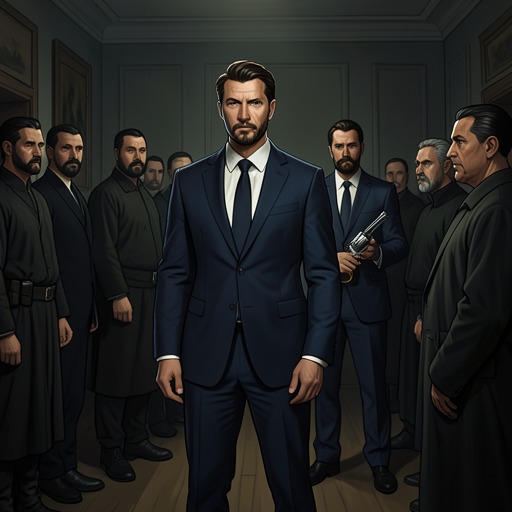
The GodfatherFabrizzio is a Sicilian shepherd whose apparent loyalty to Michael Corleone conceals the betrayal that destroys Michael's first marriage. Introduced as a quiet but worldly village man, he accompanies Michael through the countryside, watches Apollonia with growing interest, and ultimately helps set the car bomb that kills her. His distinctive chest tattoo later turns him into a hunted and recognizable fugitive; when Michael's agents find him in Buffalo, Fabrizzio is executed under his false identity, with the tattoo serving as the final proof of who he is.
Identity and Background
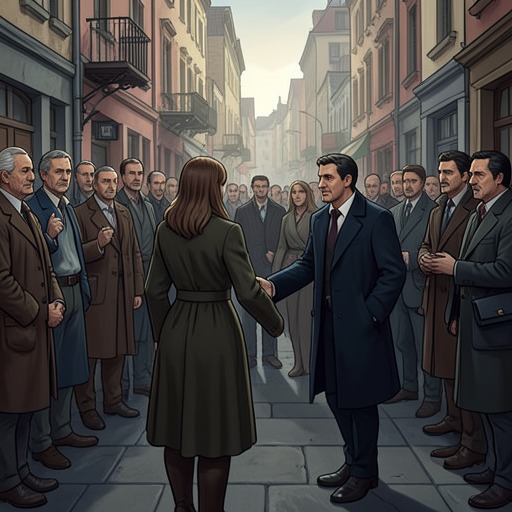
Fabrizzio belongs to the rural Sicilian world surrounding Michael's exile. He works as one of Michael's two shepherds, alongside Calo, and is described as younger and more outgoing than his companion. Unlike the silent, almost moronic Calo, Fabrizzio has seen something of the wider world: he served in the Italian navy during the war, was captured by the British after his ship was sunk, and returned to his native village with a tattoo that made him locally famous.
The tattoo is both a personal concealment and a public mark. Fabrizzio had acquired it chiefly to cover a splotchy red birthmark on his belly, yet the image itself represents a subject associated with Sicilian honor: a husband stabbing a naked man and woman entwined together. He is not entirely proud of it, but its unusual visibility later becomes the means by which Michael's organization identifies him. Fabrizzio also brings Michael fresh cheese from time to time and asks him questions about America, gestures that help establish an ordinary, companionable surface before the betrayal is revealed.
Life in Michael's Sicilian Exile
Fabrizzio serves as part of the protection surrounding Michael while Michael is hiding in Sicily. The two shepherds follow Michael across the fields, and their presence reflects the local system of protection that operates where formal law is weak. The countryside is dangerous: thieves who loot a pagliaio, a field shelter for tools and laborers, may be hunted down and slaughtered, and an innocent passerby can be suspected unless someone vouches for him. Fabrizzio therefore belongs to a landscape in which safety depends on personal testimony, local reputation, and armed loyalty.
His knowledge of America gives him a particular connection with Michael, whose nationality cannot be kept from the shepherds even though the details of his identity remain concealed. Fabrizzio jokes with him and supplies food, making himself useful not through grand authority but through proximity and familiarity. That intimacy also gives him access to Michael's household and movements, a practical advantage that later makes his betrayal especially destructive.
Betrayal and Apollonia's Death
The first visible sign of Fabrizzio's disloyalty is Michael's observation that he has been looking at Apollonia too often during the weeks before the family's departure. Michael knows that Fabrizzio would not dare openly advance toward the wife of a friend of the Don, since in Sicily such an act would invite death. The restraint is therefore not proof of loyalty; it marks the pressure surrounding a forbidden desire and foreshadows the danger already inside Michael's circle.
When Michael prepares to leave, Fabrizzio asks whether Apollonia will accompany him. Michael replies that she will first return to her family and join him a few days later. Michael then leaves the immediate area, while Apollonia remains behind and Fabrizzio goes toward the stone hut used as a garage for the Alfa Romeo. The sequence gives Fabrizzio knowledge of the car, the timetable, and Apollonia's expected movements. Shortly afterward, the automobile explodes. Michael is left unconscious for nearly a week, Apollonia is dead, and Calo has also been killed; Fabrizzio has vanished.
Don Tommasino explains that the attack had been aimed at Michael and that the Palermo people had wanted him killed while making it appear that Don Tommasino was the target. Fabrizzio's disappearance, however, reveals that the danger came through Michael's own protective circle. When Michael recovers, he remembers the deaths and demands that anyone who delivers Fabrizzio to him will receive the finest pastures in Sicily. The demand transforms Fabrizzio from an escort into the central object of Michael's first explicit revenge.
Flight, Identification, and Execution
Fabrizzio eventually reaches the United States and hides under another identity, working at a small pizza parlor in Buffalo. The disguise depends on distance and an assumed name, but it cannot erase the tattoo. A young, tough-looking customer enters during the lunch trade, asks for a slice, and then insists on seeing the supposedly famous tattoo. When the counterman denies having one and claims that the tattoo belongs to the man who works at night, the visitor refuses to accept the explanation.
The encounter becomes an execution. Fabrizzio backs toward the rear of the store around the huge brick oven, but the customer draws a gun and shoots him repeatedly in the chest. The gunman tears open the shirt, exposing the blood-covered tattoo and confirming the man's identity. He tells Fabrizzio that Michael Corleone sends his regards, then shoots him in the skull at close range before leaving in a waiting car. The delayed revenge is therefore completed through recognition: the mark Fabrizzio once carried as a village curiosity becomes the evidence that makes escape impossible.
Narrative Role and Significance
Fabrizzio's arc turns apparent guardianship into betrayal. His small acts of companionship, military experience, and familiarity with Michael's movements make him seem like a minor ally, but the tattoo, the watching eyes, and the vanished car reveal how fragile trust is within Michael's Sicilian refuge. His treachery also changes Michael's relationship to violence. Apollonia's death is not merely an external attack; it is a personal violation committed through the very network meant to protect him, and Michael answers it with a promise preserved across years.
The character's significance lies in the contrast between concealment and legibility. Fabrizzio can cross from Sicily to America and assume a new working identity, but the body continues to carry its history. The tattoo is at once a private attempt to hide a birthmark, a public emblem of Sicilian honor, and the identifying evidence that permits Michael's revenge. Fabrizzio thus survives geographically but not narratively: his flight postpones judgment, while the remembered image on his chest ensures that the past will eventually find him.